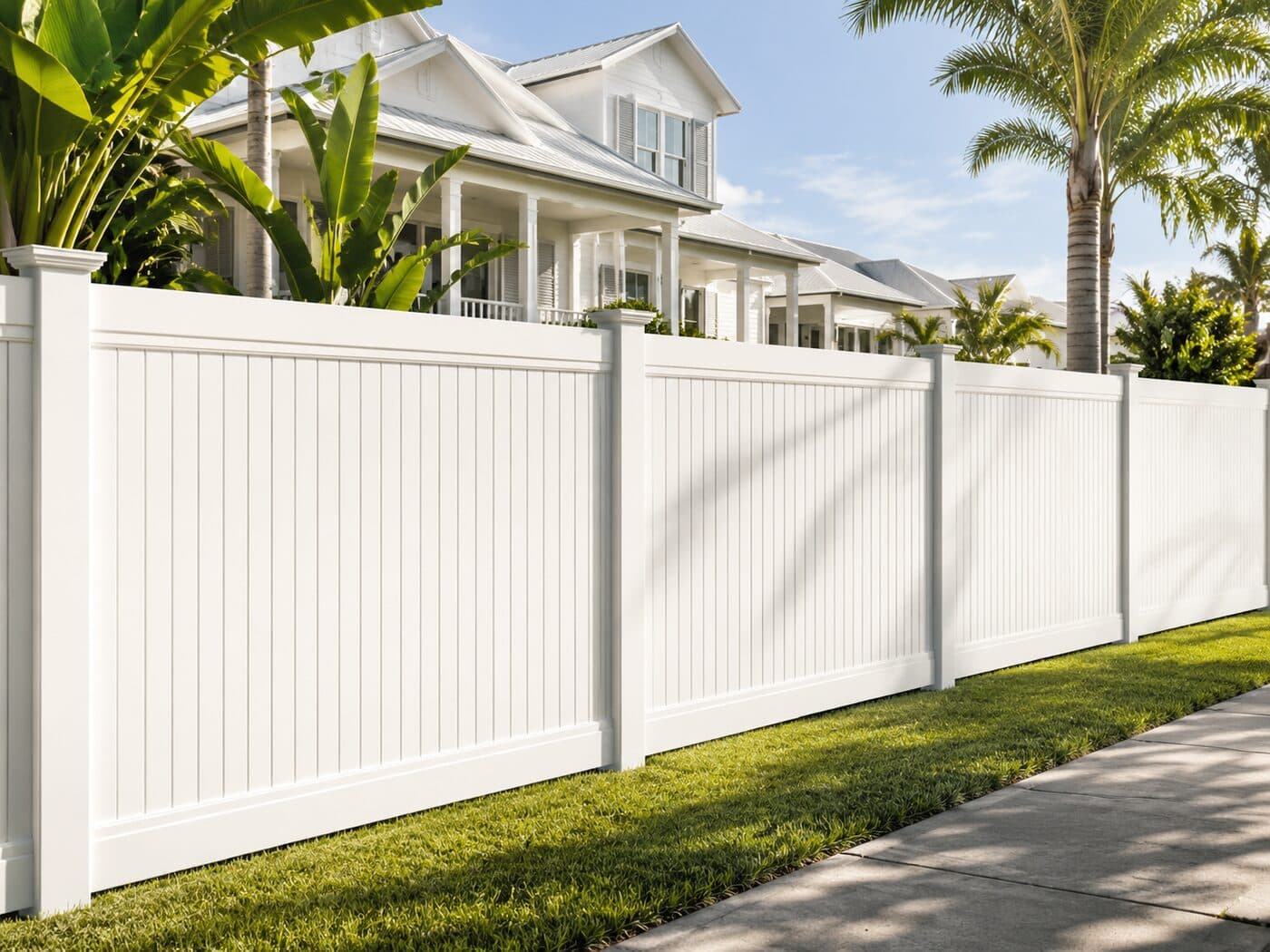
PVC Fencing Colours
Nearly every PVC fence in the world is white, and it is not because the industry lacks imagination. It is chemistry. Here is the honest version, including when you should buy something else.
The colour and the durability are the same ingredient
Raw PVC does not survive sunlight on its own. Ultraviolet light breaks the polymer chains down, and an unprotected panel would chalk, yellow and turn brittle within a few seasons. What prevents that is a package of stabilisers blended into the material, and the workhorse of that package is titanium dioxide.
Titanium dioxide stops UV mainly by absorbing it, and scatters some of it as well, so the energy never reaches the polymer. It is extremely good at this, which is why it is also a sunscreen ingredient. Separately, at the particle sizes used in pigment, it scatters visible light so strongly that it is one of the most effective white pigments known, which is why it turns up in paint, in paper and in toothpaste.
Those two jobs are not strictly the same effect. Grind the particles fine enough and you keep the UV absorption while losing the whiteness, which is exactly how transparent mineral sunscreens work. But at the loading and particle size that makes economic sense in an extruded fence panel, you get both together. So a manufacturer building a panel to survive thirty years of Australian sun ends up with a very white panel as a consequence. On a PVC fence, the white is largely the visible evidence of the thing that makes it durable.
What happens when you make it dark
Two things, and they compound. The first is that holding a colour is harder than holding white. A dark pigment has to resist fading across decades of UV while the panel underneath stays sound, and the usual answer is co-extrusion: the panel is made in two layers at once, a white structural core carrying the strength and a thin coloured outer cap carrying the colour and a concentrated dose of UV stabiliser. It works, and it is genuinely good engineering, but it is a more complex product than a single-layer white panel and it is priced accordingly. Fade is also the failure you notice most: a white panel that has aged slightly still looks white, while a charcoal panel that has aged slightly looks patchy.
The second is heat, and this is the one that matters most in Australia. A dark surface in full sun absorbs a great deal more solar energy than a white one beside it. PVC expands and contracts with temperature, noticeably so, which is why panels sit in slotted posts with room to move rather than being screwed rigidly in place. A dark panel simply has more of that movement to manage, every day, for decades. On a long unshaded run in a Queensland summer that is real engineering load, and it shows up over time as sag, as bowing between posts, and as stress where panels meet their fixings.
None of this makes dark vinyl fencing a bad product. Good ones are made well and perform. It does mean that the two things people usually assume are equivalent, a white panel and a dark panel from the same range, are not the same product with different pigment. They are different products.
If you want a dark fence, buy a different material
We sell PVC fencing, so it would be easy to argue you into white. But if you have a charcoal house with black window frames and a dark fence is the specific thing you came for, PVC is not the material for the job and we would rather say so.
Colorbond is made to be coloured. The colour is a baked-on coating over steel, the dark shades are part of the core range, and the whole system is engineered around them. Powder-coated aluminium is the same story with better corrosion behaviour near the coast. Both will give you a dark fence that is meant to be dark, rather than a PVC fence working against its own chemistry.
Our honest comparisons of both are here: PVC vs Colorbond and PVC vs aluminium. They are written to help you choose, not to make PVC win.
White is not the consolation prize
Having explained why white is what the chemistry produces, it is worth saying that it is also, for most Australian properties, the right answer anyway.
White reads as trim rather than as a wall. A dark fence is a large, visually heavy object at the edge of a small yard, and it tends to make the yard feel smaller and hotter than it is. A white boundary recedes, bounces light back into the garden, and stays cool enough to put a hand on in February. It also sits comfortably against almost any house colour, because that is the job white has always done in architecture.
And it is the only colour that never dates. A fence installed today has to still look deliberate in 2050. Fence colours that were unmissable a decade ago now read as a decade old; white does not accumulate that kind of timestamp.
The same white across every range
Because all five ranges share the one finish, you can mix them on a single property without a colour mismatch. A picket across the front, a semi-privacy run down one side, a full privacy boundary at the rear and post and rail on the paddock all read as one considered scheme rather than four different fences. With a painted fence that consistency is a maintenance commitment. Here it is just how it arrives.
Frequently asked questions
What colours does PVC fencing come in?
Why is PVC fencing always white?
Can you get black or charcoal PVC fencing?
Does white PVC fencing go yellow?
Does a white fence get dirty?
Will a white fence look wrong against a dark house?
Can PVC fencing be painted?
Does colour affect how long a PVC fence lasts?
Price a white PVC fence
Draw your fence line on a satellite map of your property and get an instant quote, with transparent pricing and no hidden costs.
Get your free quote