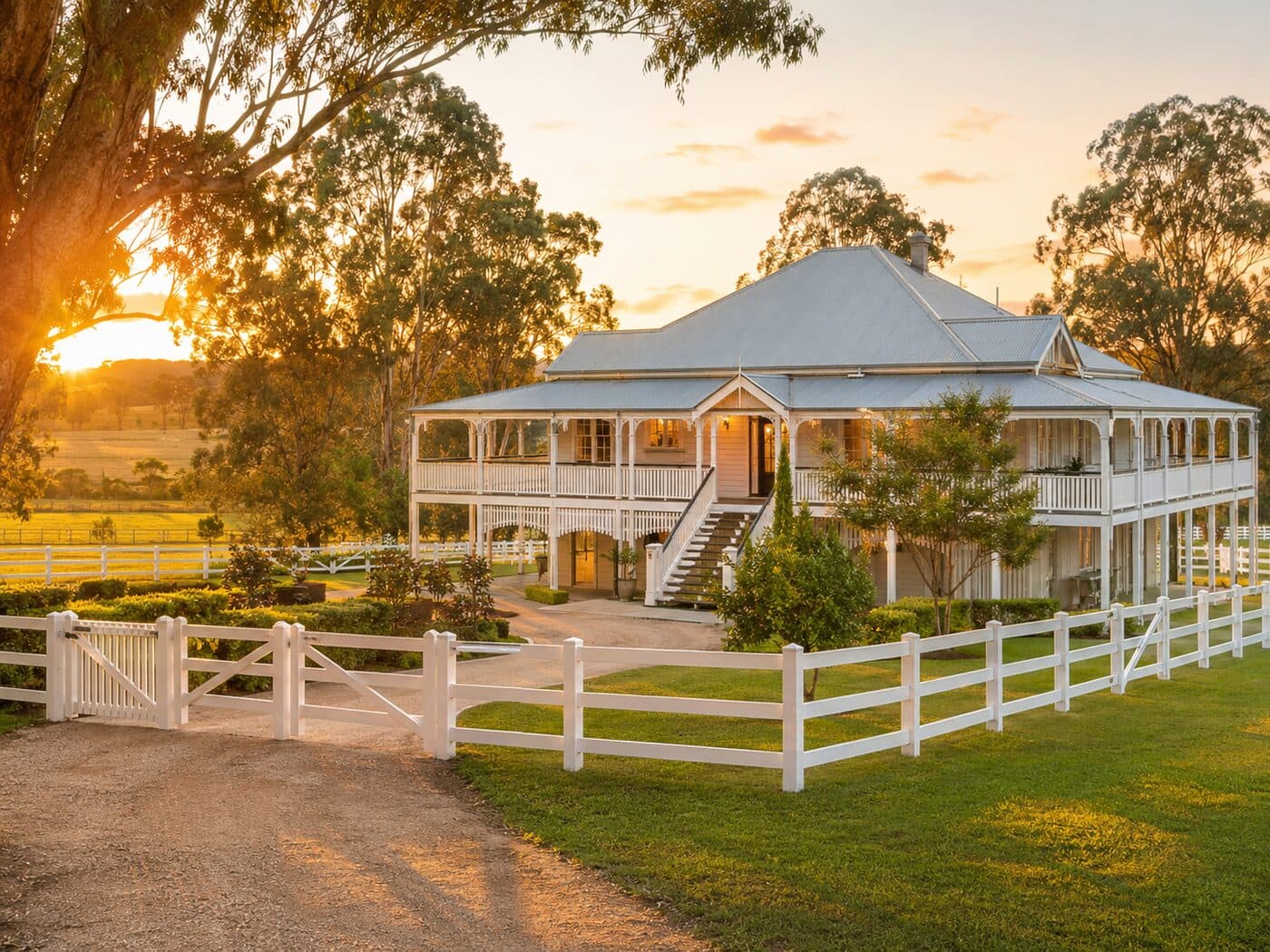
PVC Horse Fencing
Post and rail that flexes instead of splintering, has no wire to cut, and stays visible at dusk. The two most common fence injuries on a horse property are the two this fence is built to remove.
Horses do not get hurt by fences. They get hurt by what fences do when they fail
Every fence on a horse property will eventually be hit. A horse gets cast against it, spooks into it, gets pushed into it by another horse, or simply misjudges a corner at speed. You cannot design that out. What you can choose is what the fence does in the half-second afterwards, and that choice is almost entirely a choice of material.
Timber breaks. A hardwood rail is stiff, so it resists until it fails, and it fails suddenly. The energy that would have been spread over time goes into the horse instead, which is how contact with a rigid rail turns into a fracture. Then the broken rail leaves a jagged end and an exposed nail or coach screw at exactly chest and shoulder height. Lacerations are the injury a fence most commonly causes, and a broken timber rail is one of the two things that produce them. The other is wire.
Wire cuts. Thin wire under tension does not break when a horse goes through it. It stretches, wraps, and draws tight around a leg, and the damage it does to tendons in that moment is the injury every experienced horse owner has either seen or heard about. Plain wire and high-tensile in particular have no business being in a paddock where horses gallop.
PVC flexes. The rail gives, absorbs the energy over a longer moment, and springs back. That extra fraction of a second is the entire safety argument: peak force on the horse drops sharply when the barrier decelerates it rather than stopping it. And when the rail does eventually let go under extreme load, it comes out of the routed slot in the post rather than shattering into something sharp. There is no splinter, no protruding fixing, and no wire.
Two rails or three
This is the decision that matters most, and it is not really about budget. The two configurations do different jobs.
For horses
3-Rail, 1.3m
Tall enough to read as a real barrier, with rails at the heights a horse actually registers. This is the configuration for paddocks, arena surrounds and any boundary containing horses.
For boundaries
2-Rail, 0.9m
A visual line: driveways, house yards, paddock divisions and larger settled stock. Handsome and quick to install, but a foal will walk under it and a determined horse will step over.
Why stud fencing has always been white
Long before PVC existed, serious horse properties painted their post and rail white, and repainted it, endlessly. Whitewash was cheap and it protected the timber, but the reason the convention stuck is that it works: a white rail is about the most visible barrier you can put in front of a horse at dusk, in dust, in rain, or at the moment something has frightened it and it is moving without looking. Horses hit fences they have not seen.
PVC gives you that visibility as a permanent property of the material rather than a coat of paint with a three-year clock on it. The white is through the panel, and the reason it stays white is the same UV stabiliser that keeps the rail from going brittle. On a horse property the safety benefit and the maintenance benefit happen to be the same feature.
Where PVC is not the right fence
A post and rail fence is a barrier a horse respects, not a barrier a horse cannot pass. That distinction is worth being clear about before you spend money.
It will not contain anything small. Sheep, goats, calves and dogs go straight through the gaps, and if you are running mixed stock you will want mesh behind the rails on those boundaries. It is not a round yard fence, because a round yard takes deliberate, repeated contact under working pressure and needs a system engineered for exactly that. And in genuinely high-pressure spots, along a feed line, either side of a gate, or on a boundary where two horses want to get at each other, a strand of electric along the top is still the right answer regardless of what the fence is made of.
Used for what it is good at, which is paddock boundaries, arena surrounds, laneways and property frontages, it is hard to beat. Used as a containment system for a horse determined to leave, no post and rail fence in any material is going to hold.
What it costs against timber
A Cotswold section spans 2.44 metres from post centre to post centre and is priced as a complete set: the rails, the post and the cap. The 3-rail works out at $97.75 a section including GST. Per-section pricing for both configurations is on the Cotswold range page. On day one it lands close to good hardwood post and rail. The gap opens up afterwards.
A painted timber fence wants repainting every three to five years, which on a horse property is not a weekend, it is a season. Rails rot at the ground line and get replaced in ones and twos for the life of the fence, and each replacement is a new rail that does not match the weathered ones beside it. PVC removes both of those recurring jobs entirely. Over twenty-five years the comparison is not close, which is the same argument the PVC versus timber comparison makes in full.
Same fence, other jobs
If you are fencing a rural block rather than a horse property, the same Cotswold rails do the work without the equine considerations on this page. There is a broader look at PVC post and rail fencing as a style and a format, and the full farm fencing range with specifications and pricing.
Frequently asked questions
Is PVC fencing safe for horses?
Should I use 2-rail or 3-rail for horses?
Will horses chew or crib on PVC fencing?
How much does PVC horse fencing cost in Australia?
Does PVC horse fencing break if a horse leans on it?
Is white PVC fencing better for horses to see?
Can I use PVC fencing for an arena or round yard?
Will PVC horse fencing contain other animals?
Price your horse fencing
Draw your paddock lines on a satellite map of your property and get an instant quote, with transparent pricing and no hidden costs.
Get your free quote