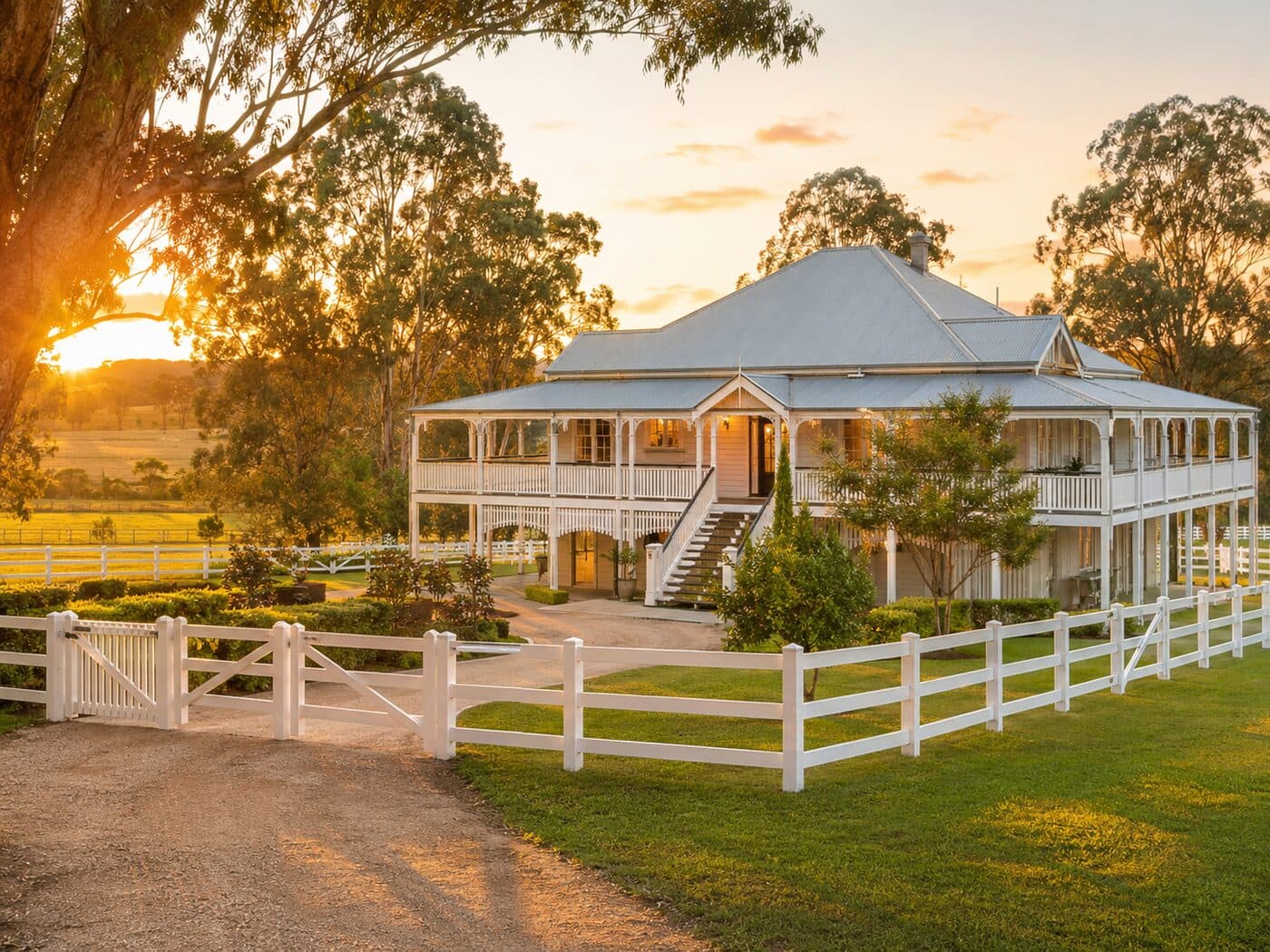
PVC Post and Rail Fencing
The oldest fence format there is, in a material that finally suits it. Rails slot through the posts instead of being nailed to them, so there is nothing to work loose and nothing to repaint.
The rails go through the posts, not onto them
This sounds like a detail and it is actually the whole difference between this fence and the timber version it replaces.
On a traditional post and rail fence the rails are fixed to the face of the post with nails, screws or coach bolts. Every one of those fixings is a small hole in a piece of timber that swells in the wet and shrinks in the dry, being asked to hold against wind, against stock leaning, and against the rail's own weight, for decades. They loosen. That is not a workmanship problem, it is what fasteners in timber do, and it is why an old post and rail fence has that characteristic slight sag and rattle.
A PVC post is routed with openings all the way through it, and the rail passes through the post rather than sitting against it. The post carries the rail in compression along its full bearing surface. There is no fastener in the connection at all, so there is nothing to work loose, nothing to rust, and nothing to pull through. It is a better joint than the one the format was originally built with.
Where post and rail belongs
The reason this format has survived four hundred years is that it draws a line without building a wall. On a rural or semi-rural block, that is usually exactly what you want at the front: a boundary that says where the property begins while leaving the land, the trees and the house visible from the road. A solid fence on an acreage frontage looks defensive and makes the block feel smaller than it is.
It is at its best on a driveway entrance, where a 3-rail run either side of the gates with a matching gate between them is the classic country property arrival, and it does more for the look of a rural block than almost any other single change. It works along road frontages, down laneways, around house yards inside a larger property, and as paddock divisions where you want to see across your own land.
Where it does not belong is a suburban backyard. At 0.9m or 1.3m with open rails it gives no privacy, no security and no containment, and on a small block it will read as decoration rather than a fence. If that is your situation, the picket range is the front-boundary answer and the privacy range is the one for the sides and rear.
Two rails or three
Both are the same fence built to a different height. Choose on what the fence is for and how substantial you want the frontage to read.
The lighter line
2-Rail, 0.9m
Low and understated. Best for driveway edges, garden boundaries and dividing lines inside a property where you want definition without weight.
The full frontage
3-Rail, 1.3m
The taller, more substantial read, and the one that makes an entrance. This is the configuration for road frontages, gate runs and any boundary holding livestock.
Setting out matters more than it does on other fences
On most fences you can absorb a bit of inaccuracy: panels get trimmed, wire gets tensioned, the last section takes up the slack. Post and rail does not give you that. The rails are a fixed 2.388 metres and seat into routed openings in each post, which sets post centres at 2.44 metres. The only tolerance you have is the depth the rail seats into the post, so a post set materially wide of the line will not take a rail at all. Mark the whole run out and check it before any concrete goes in.
The same applies to ground. Because rails slot horizontally through the posts, the fence steps down a slope in rail-length increments rather than following the ground continuously. On gentle undulation this looks entirely natural and is how rural post and rail has always been built. On a steeper or more irregular site it wants thinking about before the first post goes in, and that is a conversation worth having with us rather than a decision to make on the day.
Against timber post and rail
Timber is the alternative almost everyone is weighing this against, and on the day the fence goes up, timber looks like a fair fight. Installed cost is comparable. The difference is entirely in what happens next.
A timber post and rail fence has three recurring jobs built into it. Painting, every three to five years if you want it to stay white, and on a long rural frontage that is a serious undertaking. Rail replacement, because the bottom rail sits closest to the ground, holds moisture, and goes first, and each replacement rail is visibly newer than its neighbours. And post replacement at the ground line, which is the expensive one because it means digging out concrete.
PVC has none of the three. Across twenty-five years that is not a small saving, it is the difference between a fence you maintain and a fence you own. The full PVC versus timber comparison runs the numbers properly.
If there are horses behind it
Everything on this page is about post and rail as a boundary and a style. If the fence is containing horses, there is a separate set of considerations, impact behaviour, rail height, visibility at dusk and where electric still earns its place, covered on the PVC horse fencing page. The Cotswold range page has the full specifications and pricing for both.
Frequently asked questions
What is post and rail fencing?
How far apart are the posts on a PVC post and rail fence?
Is PVC post and rail as strong as timber?
How much does PVC post and rail fencing cost?
Does PVC post and rail fencing work on sloping ground?
Will post and rail fencing keep my dog in?
How long does PVC post and rail fencing last?
Can I install PVC post and rail myself?
Price your post and rail
Draw your fence line on a satellite map of your property and get an instant quote, with transparent pricing and no hidden costs.
Get your free quote